Antarctic
Description & Features
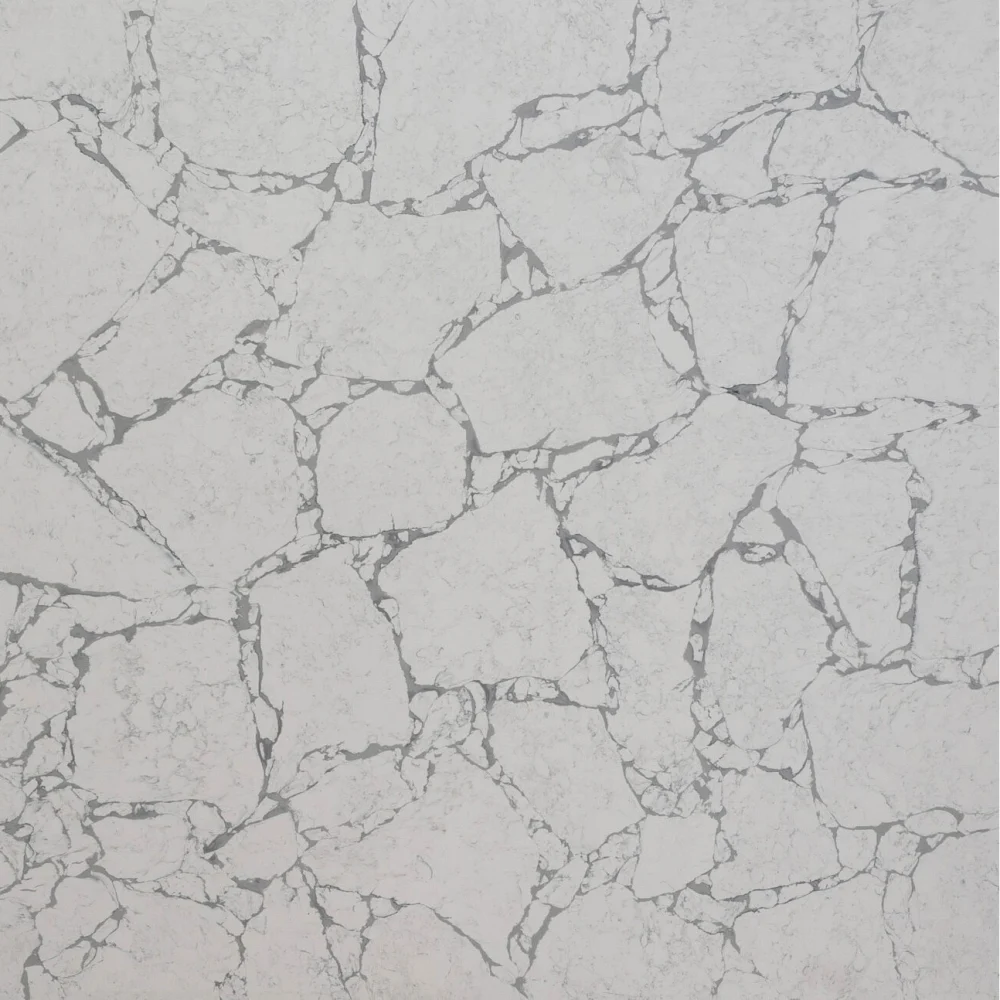
The Antarctic pattern recalls a dry-stone wall or a mosaic of broken slabs: light grey-white, slightly clouded polygons of different sizes are separated by a continuous network of grey veins filled with small white fragments, spread evenly across the whole slab. A natural quartzite is also sold under the same name, but the Antarctic in our collection is engineered quartz: a composite of quartz grains and powder, around 90% by weight, bound with resin and pigments and vacuum-compacted with vibration so that it has practically no pores. Thanks to the quartz it has a hardness of about 7 on the Mohs scale and withstands the mild acids of the kitchen far better than marble, while its dense body does not absorb oil, wine or coffee and never needs sealing. The bold pattern hides crumbs and the small marks of everyday life and gives character to kitchen and bathroom countertops, islands, splashbacks and interior wall cladding. Like all quartz surfaces it is meant for interiors: the resin does not tolerate permanent exposure to the sun, while hot cookware and sudden temperature changes can damage it, so a trivet always goes underneath. A damp cloth with a mild detergent is enough for daily cleaning; the technical values on this page are typical values for the category.
Why choose Antarctic
- Graphic "broken slab" pattern in grey-white
- No sealing – does not absorb stains
- Hardness ≈7 Mohs, scratch resistant
- The pattern hides crumbs and small marks
Technical Specifications
| Material | Engineered quartz composite – quartz grains bound with resin and pigments, vacuum-compacted |
| Color & Pattern | Light grey-white background divided into irregular polygons by a dense network of grey veins with small white fragments ("broken slab" pattern) |
| Hardness (Mohs) | ≈7 (quartz grains – typical value for engineered quartz) |
| Density (g/cm³) | ≈2.3–2.5 (typical value for engineered quartz) |
| Water Absorption (%) | ≤0.05 (typical value for engineered quartz – practically non-porous) |
| Compressive Strength (MPa) | ≈150–250 (typical range for engineered quartz) |
| Flexural Strength (MPa) | ≈35–65 (typical range for engineered quartz) |
| Frost Resistance | Its near-zero absorption typically gives good freeze–thaw resistance, but it is not intended for outdoor use, because the resin is degraded by ultraviolet radiation |
| Acid Sensitivity | Withstands the mild acids of the kitchen (lemon, vinegar, wine) – quartz is not attacked the way marble is; avoid strong acids and alkalis, solvents and oven cleaners |
| Recommended Finishes | Polished, Honed – subject to availability |
Common Applications
Frequently Asked Questions
Export & project supply
SKARIS MARBLE supplies Antarctic to stone importers, fabricators, architects and hotel projects outside Greece. From our facility in Thessaloniki we handle the whole order in-house:
- Slab selection and matching – we grade and match the slabs for colour and veining, so a large order stays uniform across the whole project.
- Cut-to-size and finishing – pieces cut, edged and finished to your drawings, numbered per room or elevation and ready to install.
- Mixed shipments – Greek marbles, granites, porous limestone (porolithos) and quartz surfaces can be combined in one order.
- Export packing – crated and labelled for sea or road freight, ex-works Thessaloniki; delivered terms quoted on request.
Send us your drawings or quantities and we will come back with a quotation and availability.